
THE EXODUS
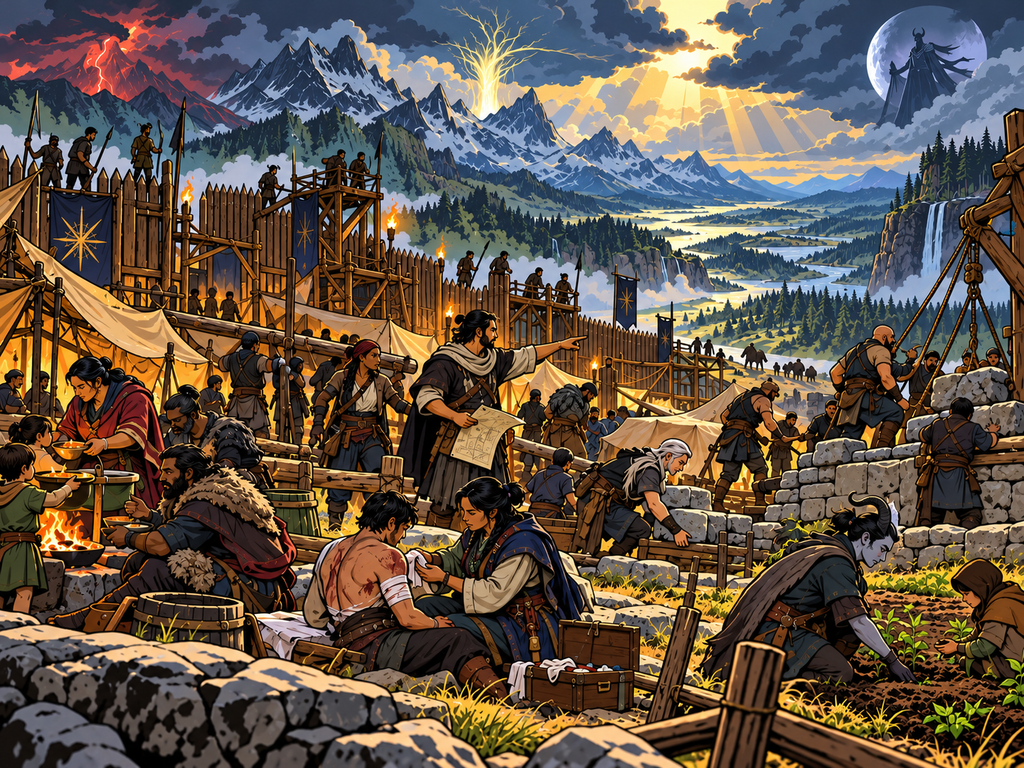
The Stolen Peoples Who Chose a World of Their Own
Archive Classification: History — Foundational Migration
Era: Pre-Imperial Sangara
Primary Archivist: Professor Ethox Stripes
Archive: The Crooked Chronicle
“Later civilizations would remember the Exodus as the beginning of Sangaran history.
For those who actually lived through it, history was probably the least important thing on their minds.
They were trying to survive.”
— Professor Ethox Stripes
Before there was a Xin Empire, there was no emperor.
Before there was a capital, there was no city.
Before Sangara became home to nations, roads, temples, markets, rune rails, skyships, and generations of people who could scarcely imagine living anywhere else—
there were refugees.
Thousands of them.
Perhaps more.
They came from different peoples, different cultures, different languages, different faiths, and—if the oldest accounts are correct—different worlds.
They possessed no shared homeland.
No shared ancestry.
No single history.
What they shared was captivity.
And eventually, escape.
That escape became known simply as:
The Exodus.
THE FIRST WORLD
The peoples who would eventually settle Sangara did not originate together.
Their captivity brought them together.
Surviving traditions place them within what later records call the First World, a realm remembered as magnificent, dangerous, and dominated by powers whose relationship with mortal life was rarely equitable.
Among those powers were the beings collectively remembered as the Fae Ones.
Descriptions vary considerably.
Ancient accounts speak of courts of impossible beauty, bargains whose meanings shifted after they were spoken, palaces that changed with the seasons, rulers who measured time differently from their servants, and powers capable of reshaping both living things and the land around them.
These descriptions should be approached carefully.
Ancient captives were not conducting ethnographic surveys.
They were attempting to stay alive.
What can be reconstructed with greater confidence is that the Fae Ones maintained enormous populations of captives drawn from somewhere beyond the First World itself.
THE STOLEN PEOPLES
The captives were not one conquered civilization.
They had been gathered.
Stolen during raids.
Kidnapped from isolated settlements.
Taken through planar crossings.
Purchased through markets whose surviving descriptions are unpleasantly literal.
Exchanged between powerful beings.
Inherited.
Captured in conflicts that had nothing to do with the First World.
Some were taken individually.
Others were taken by the village.
Some knew precisely where they had come from.
Others possessed only stories inherited from parents or grandparents who remembered another sky.
For still others, captivity had lasted so long that their original homeland survived only as fragments of song, ritual, language, or family tradition.
The Fae Ones had assembled, intentionally or otherwise, a population drawn from across the multiverse.
Humans lived beside peoples they had never encountered before.
Different physiologies required different food, shelter, and medicine.
Languages collided.
Religions disagreed.
Customs that seemed obvious to one community appeared incomprehensible to another.
They were not one people.
Captivity had simply placed them in the same place.
Bridget’s Note: Histories often use the word refugees as though it describes a culture. It describes a circumstance.
WAR ABOVE THEM
Their captivity did not occur in isolation.
The Fae Ones were themselves engaged in conflict with another collection of powers remembered as the Far Lords.
Little about this war can be stated without qualification.
Its origins remain disputed.
Its duration is uncertain.
Accounts disagree over whether the Far Lords represented invaders, rivals, ancient enemies, competing powers, or something for which later historians possess no satisfactory category.
It is entirely possible that several descriptions are simultaneously true.
To the captives, however, such distinctions were largely academic.
They experienced the war from beneath it.
Territories changed hands.
Fortresses fell.
Supply systems collapsed.
Captives were relocated.
Communities disappeared.
Resources became scarce.
Orders became increasingly desperate.
The great powers of the First World fought one another.
Those without power endured the consequences.
Yet war creates disorder.
And disorder creates openings.
Somewhere amid the violence between the Fae Ones and the Far Lords, people who had spent generations believing escape impossible began to realize that the impossible had become merely unlikely.
That was enough.
SHAO XIN
Later histories would place crowns upon Shao Xin.
This has occasionally distorted our understanding of the man who existed before those crowns.
During the Exodus, Shao Xin was not an emperor.
He did not command an empire.
He did not even command a unified people.
He possessed something considerably more useful.
The ability to make people cooperate.
The captive communities had every reason to distrust one another.
They had different priorities.
Different traditions.
Old grievances.
Different ideas about where they should flee, how they should travel, who should carry scarce supplies, who should defend the vulnerable, and who—if anyone—had the right to make decisions for everyone else.
Escape on a large scale required organization.
Xin became one of the central figures capable of providing it.
He negotiated between groups.
Coordinated routes.
Organized defenders.
Managed supplies.
Persuaded rival communities to travel together.
Helped establish systems in which those with particular skills supported those without them.
He did not erase their differences.
He convinced enough people that those differences mattered less than survival.
This was perhaps the first truly Sangaran political act.
Not conquest.
Not coronation.
Cooperation.
Bridget’s Note: Later rulers were very fond of depicting Shao Xin standing alone at the front of the Exodus. Contemporary evidence suggests he spent considerably more time in meetings.
THE ESCAPE
No surviving account provides a complete reconstruction of the Exodus.
This is unsurprising.
People escaping captivity rarely stop to produce reliable documentation.
What survives instead are fragments.
Songs describing impossible roads.
Stories of hidden gates.
Accounts of battles fought only to buy several hundred people enough time to flee.
Family traditions about children carried through collapsing passages.
Religious accounts claiming divine intervention.
Records of individuals who remained behind voluntarily so that others could escape.
Names survive.
More names have been lost.
The journey appears to have occurred across multiple stages rather than as one clean departure.
Some groups escaped earlier.
Some joined later.
Some never reached the destination.
Others disappeared somewhere between worlds.
The farther one moves from surviving testimony, the more the Exodus becomes legend.
Yet eventually, enough of the refugees crossed whatever boundaries separated them from the First World.
They escaped their captors.
They escaped the war.
They escaped into a new world.
And discovered that the new world was trying to kill them.
SANGARA
Modern paintings frequently depict the arrival in Sangara beneath brilliant skies.
This is artistic optimism.
The earliest surviving accounts describe something rather less welcoming.
Sangara was harsh.
Large regions appear to have been barren, unstable, poisonous, volcanically active, magically volatile, overrun with dangerous life, or otherwise poorly suited to supporting enormous populations of exhausted refugees.
The climate was unpredictable.
Food was uncertain.
Water could not always be trusted.
Predators unfamiliar with mortal settlements regarded the new arrivals with varying degrees of curiosity.
Several of the more enthusiastic varieties apparently considered them edible.
The refugees had escaped.
They had not reached safety.
Indeed, the first generations appear to have regarded Sangara less as a promised land than as the only land available.
And so the coalition that had made escape possible became essential once again.
Had the communities scattered immediately, many would likely have died.
Instead, they remained together.
Hunters shared knowledge.
Healers compared medicines from worlds that had never previously touched.
Builders adapted foreign techniques to unfamiliar materials.
Mages experimented.
Farmers discovered what could grow and what absolutely should not be eaten twice.
Different peoples learned from one another because Sangara gave them very little alternative.
A society began forming out of necessity.
THE POWERS WHO CAME WITH THEM
The Exodus traditions also speak of beings later regarded as gods.
Here, as elsewhere in the Chronicle, terminology requires caution.
The word deity should not be understood as a precise taxonomic classification. It describes beings of extraordinary power, influence, or metaphysical significance which cultures have reasonably understood as divine.
Among the powers consistently associated with the early Sangaran traditions are:
Vyrmalkyn.
Nocticula.
Eos.
And others whose names have survived less clearly.
Numerous traditions claim that these powers either accompanied the refugees into Sangara or became involved in their survival shortly thereafter.
The stories describe acts of cultivation on an extraordinary scale.
Storms quieted.
Rivers redirected.
Soil made fertile.
Forests encouraged to spread.
Dangerous regions stabilized.
Predators driven from settlement lands.
Places of refuge created where none had previously existed.
Whether these stories record literal world-shaping acts, generations of mortal labor attributed retrospectively to divine patrons, or some combination of both remains unresolved.
Such distinctions may also matter considerably less than scholars occasionally pretend.
The Sangara encountered by the first refugees was hostile.
The Sangara inherited by later generations was dramatically more habitable.
Something changed.
Many traditions remember who helped.
Bridget’s Note: Professor Stripes originally wrote six paragraphs explaining why “terraforming” is an unsuitable term. They have been removed for public safety.
VYRMALKYN AND MORTAL MAGICK
Vyrmalkyn occupies a particularly unusual place in traditions surrounding the early world.
The black-and-gold wolf god is remembered not merely as one of the powers associated with the refugees, but as the thief who brought magick into mortal hands.
Older traditions disagree regarding precisely when this occurred.
Some place the theft before the Exodus.
Others associate it directly with the escape.
Still others argue that chronology is largely meaningless in stories involving entities such as Vyrmalkyn.
The central claim remains consistent:
Magick had been denied to mortals.
Vyrmalkyn stole it.
Mortals kept it.
For peoples attempting to survive an unfamiliar and hostile world, this was not merely a theological curiosity.
Magick became another tool with which Sangara could be transformed.
Shelters could be protected.
Land could be cultivated.
Injuries could be treated.
Distances could be crossed.
Threats could be fought.
The refugees had arrived with very little.
They nevertheless possessed something their captors had apparently never intended them to have.
Power of their own.
THE FIRST HEARTH
Survival required somewhere permanent.
The refugees established a central settlement within the land they were beginning to cultivate.
Its earliest form was unlikely to have impressed later imperial architects.
Shelters.
Storehouses.
Defensive works.
Communal kitchens.
Places for healing.
Workshops.
Shrines.
Pens.
Wells.
Walls built because something outside them had attempted to eat somebody.
No emperor designed this settlement.
No royal avenue determined its shape.
It grew according to need.
Shao Xin again became important here.
The coalition required to escape the First World had to become something capable of surviving peace—or what passed for peace in early Sangara.
Resources needed distribution.
Disputes required mediation.
Defenses needed coordination.
People needed rules governing land, trade, obligations, and communal labor.
Perhaps most importantly, people who had spent generations being treated as possessions needed to begin deciding what it meant to belong somewhere without belonging to someone.
The settlement endured.
Temporary shelters became homes.
Paths became streets.
Storehouses became markets.
Walls expanded outward.
Children were born who had never seen the First World.
Their children would know Sangara not as refuge, but as home.
FROM REFUGE TO CAPITAL
The settlement grew.
Centuries passed.
Institutions emerged.
Leadership changed.
Coalitions hardened into political structures.
The name Xin acquired meanings that Shao Xin himself could not possibly have foreseen.
Eventually, the settlement founded by refugees became the heart of something vastly more powerful.
The Xin Empire.
Where communal halls had once stood, imperial buildings rose.
Where exhausted refugees had gathered supplies, merchants and officials eventually crossed enormous plazas.
Fortifications became monuments.
The settlement became a capital.
The capital became a symbol of imperial authority.
The people who had once escaped domination eventually produced rulers capable of imposing it.
History contains few cleaner examples of why origin stories should not be mistaken for guarantees.
Bridget’s Note: A noble beginning is not inherited automatically by every institution built afterward.
Shao Xin did eventually become central to the political legacy that carried his name.
But the emperor belongs to a later chapter.
The Shao Xin of the Exodus deserves to be remembered first as the man helping very different peoples learn how not to die separately.
THE CITY THAT REMAINED
The Xin Empire eventually fell.
Its capital did not disappear entirely.
Cities rarely oblige historians so neatly.
The ruins remained.
The foundations remained.
The roads remained.
Generations later, new people built over them.
Today that ground is occupied by Kharavel.
Rune Rails pass over ancient foundations.
Skyships descend toward terminals above streets once crossed by imperial processions.
Homes, markets, universities, workshops, restaurants, stations, and government offices occupy land first settled by people who arrived possessing almost nothing.
Kharavel does not consider itself the continuation of the Xin Empire.
Nor should it.
But beneath the modern city is the physical record of nearly the entire Sangaran political arc:
Refuge.
Settlement.
Capital.
Ruin.
City.
The ground remembers even when governments do not.
THE RETURN TO THE PLANES
Perhaps the strangest legacy of the Exodus can be found not in ancient ruins, but in modern transportation.
The ancestors of Sangara’s peoples were taken from across the multiverse.
They crossed planes because someone else forced them to.
They were stolen.
Bought.
Traded.
Carried through doors they did not choose to open.
Modern Sangarans increasingly travel those same boundaries willingly.
They cross worlds for trade.
Scholarship.
Diplomacy.
Pilgrimage.
Exploration.
Adventure.
Sometimes merely because the other side looks interesting.
Places such as Veilport have made planar travel part of the ordinary reality of the modern age.
A Sangaran traveler can now stand before a crossing, examine the destination, purchase passage, and decide for themselves whether to step through.
There is something difficult to ignore in that.
A civilization descended from people scattered across worlds by force has learned how to reach those worlds again by choice.
The first generation had doors opened for them by captors.
Their descendants build doors of their own.
WHAT THE EXODUS CREATED
It is tempting to describe the Exodus as the founding of Sangara.
This would be inaccurate.
The world existed before the refugees arrived.
Something lived there.
Something shaped it.
Much remains unknown.
The Exodus instead marks the beginning of the Sangara familiar to us today.
Its cultures descend from many worlds.
Its magick carries the memory of theft and liberation.
Its religious traditions preserve stories of powers who helped mortals survive.
Its political history begins with cooperation before eventually producing empire.
Its greatest modern city stands atop the place where refugees first gathered around a shared hearth.
Even its growing relationship with the wider multiverse echoes the conditions that created its first peoples.
Sangara was not one homeland carried intact into another world.
It was something new.
Built by people who had lost their old homes.
And perhaps that is why Sangara has always been unusually comfortable with the idea that belonging does not require having begun somewhere.
FROM THE DESK OF PROFESSOR ETHOX STRIPES
Later generations turned the Exodus into monuments.
That is what later generations do.
They carved Shao Xin standing tall.
They painted gods reshaping mountains.
They wrote speeches nobody recorded and placed banners where exhausted refugees probably carried sacks of food.
Perhaps none of that is entirely wrong.
But I prefer the smaller evidence.
A cooking vessel repaired six times.
A child’s toy made from wood not native to the First World.
Two burial traditions practiced beside one another.
A foundation expanded three separate times because more people kept arriving.
These tell us what the monuments cannot.
The Exodus succeeded because people who had every reason to think only of themselves eventually chose to build something together.
They escaped as captives from a hundred worlds.
They survived as neighbors.
Their descendants called the place Sangara.
— Professor Ethox Stripes
Bridget’s Editorial Note: No corrections.
A Hundred Worlds
Read The Lyrics
[Verse 1]
We had names from different skies
Different prayers and different lives
Different words for home and rain
Same cold iron, same damn chains
Then the old world split with war
Someone found an open door
No great banner, no command
Just a thousand reaching hands
[Pre-Chorus]
Run together
Or die alone
There was nowhere left called home
[Chorus]
From a hundred worlds
We came as one
Through the dark
Toward an unknown sun
No crown above
No road below
We had nowhere left to go
From a hundred worlds
Through blood and storm—
We made one home
[Instrumental]
[Verse 2]
Freedom wasn’t fertile ground
No safe walls were waiting round
Bitter water, burning skies
Hungry things with stranger eyes
So the healer shared her thread
The hunter split his final bread
Hands that never should have met
Built the first wall standing yet
[Pre-Chorus]
Stay together
Hold the line
Your life is yours
And mine is mine
[Chorus]
From a hundred worlds
We came as one
Through the dark
Toward an unknown sun
No crown above
No road below
We had nowhere left to go
From a hundred worlds
Through blood and storm—
We made one home
[Instrumental Build]
[Bridge]
Some say gods came down beside us
Turned the river, broke the stone
Some say mortal hands did all of it
Maybe both can still be known
The wolf brought fire into our hands
The fields grew green where nothing grew
But gods alone did not build Sangara—
People did that too
[Quiet Instrumental]
[Verse 3]
First came shelters
Then came streets
Children running under trees
Then came markets
Then came walls
Then came banners over all
Years put marble over mud
Kings put gold where hearthfires stood
But underneath each palace stone
Was the place we made our home
[Final Chorus]
From a hundred worlds
We came as one
Through the dark
Toward an unknown sun
No chains above
No cage below
Now we choose the roads we go
From a hundred worlds
Look what we’ve become—
We made one home
[Final Refrain]
Once they dragged us through the doors
Now we open them ourselves
Once they scattered us through worlds
Now we cross them by ourselves
A hundred worlds
A thousand roads
One Sangara
One home
[Outro]
Different skies
Different names
One fire
One flame
We were stolen
We came home
[End]


