
The Seven Founding Peoples of Sangara
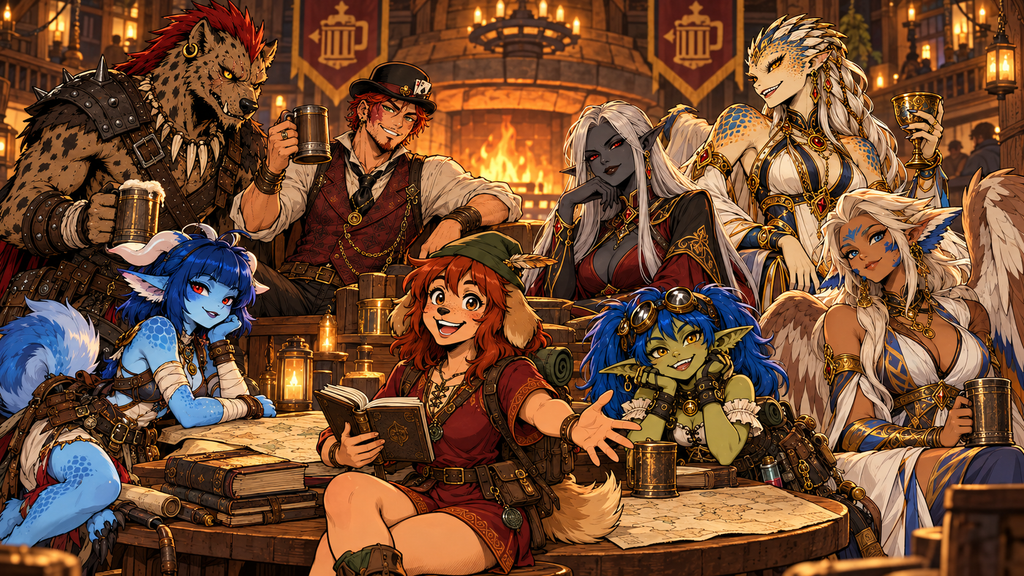
A Ruinrunner’s Guide to the Civilizations That Shaped a World
By Bridget Bell
Historical review: Professor Ethox Stripes, whom Tavri Mossclaw somehow persuaded to leave his study.
There’s a funny thing about history. Put seven figures on a monument, give them solemn expressions, and everyone assumes they were the best of friends.
I’ve climbed over enough broken monuments to know that stone has a habit of leaving out the arguments.
Sangara’s Seven Founding Peoples—Humans, Gnolls, Kobolds, Gobkyn, Drow, Xatharin, and Ishkari—helped shape the civilizations whose legacies still surround us. Their customs, knowledge, conflicts, and alliances influenced everything from trade routes and government to religion and magick.
But here’s the first thing any respectable Ruinrunner ought to know: the Seven did not found the world, and they didn’t all arrive here together.
Five Who Crossed, Two Already Home
Long before the Xin Empire, the Exodus brought five peoples to Sangara: Humans, Gnolls, Kobolds, Gobkyn, and Drow. Their ancestors crossed out of divine bondage into an unfamiliar world, carrying what they could preserve of their cultures.
The Xatharin and Ishkari were already here. They had homelands, histories, and civilizations of their own before the newcomers arrived.
The title Seven Founding Peoples reflects the later political order that bound their histories together, particularly through Shao Xin’s imperial accords. It doesn’t mean seven tribes stepped off the same boat and built a kingdom before supper.
That would have been a very crowded boat.
I. Humans — The Restless Builders
Humans have a talent for arriving somewhere, putting up a fence, and arguing about who owns the other side.
Adaptability became one of humanity’s great strengths. Settlements developed into towns and competing kingdoms, while their people exchanged ideas with neighbors and repeatedly reinvented their ways of living. Their most consequential figure was Shao Xin: a mortal hero who ascended to divinity and founded the empire bearing his name.
Unfortunately, imperial histories often make it sound as though humans invented civilization while everyone else stood around admiring the masonry. They didn’t. The roads, crafts, and knowledge that sustained Xin were the work of many peoples.
Humanity’s story is larger than its most famous emperor—and larger than the tyranny of those who followed him.
II. Gnolls — The Clans Beyond the Horizon
I’m fond of a good road. The Gnolls took one look at all that inconvenient water and decided roads ought to float.
The seafaring Gnolls of Qazhara became known for their clan-ships and maritime traditions. A vessel could be a home, livelihood, and inheritance all at once. Their voyages connected distant communities, carrying goods, news, customs, and the sort of negotiations that keep a merchant’s teeth firmly in their head.
Their contribution wasn’t simply trade; it was connection. Where a landlocked kingdom saw a vast separation, Gnoll sailors saw a route waiting to be learned.
Imperial maps later marked those sea lanes as belonging to a crown. Funny how rarely a crown mentions the clans who sailed them first.
III. Kobolds — The Patient Minds
Never underestimate a Kobold. Particularly when they’ve assured you the floor is probably safe.
Kobold civilization is distinguished by its traditions of scholarship, invention, skilled craft, and preserved knowledge. The High Council of Nine is a defining institution of their governance, reflecting the importance of deliberation and wisdom that outlasts any single ruler.
Kobold contributions aren’t always announced by enormous statues. Sometimes the legacy is a method, a mechanism, or a careful set of notes that lets the next generation solve something their ancestors couldn’t.
I admire that. I only wish some of their mechanisms came with warning labels large enough to read before I step on them.
IV. Gobkyn — Those Who Make a Hearth
If you want to understand the Gobkyn, don’t start with their height. Start with what they can build from three bent nails, an empty kettle, and an idea everyone else dismissed.
Gobkyn cultures place great value on ingenuity and belonging. Wander-kyn carry families and traditions across the world; Hearth-kyn establish enduring homes and local ties. Different ways of living, but both answer an important question: how do we keep our people together?
Their wider leadership includes the Grand Elder, presently Mavva Veshka. Yet their strength is just as visible in workshops, shared meals, and communities built through choice as well as birth.
The Exodus survivors didn’t merely need somewhere to stand. They needed somewhere to belong. The Gobkyn have never forgotten the difference.
And yes, the little Tinkerwitch at the Mughouse is an excellent example. Also an excellent reason never to touch an unattended invention.
V. Drow — The Houses of the Deepwood
People have told frightening stories about the Drow for so long that it’s a wonder anyone remembers to ask the Drow what they think.
After the Exodus, Drow society took root in the Deepwood. Its powerful Houses, guarded traditions, and intricate politics became defining features of its civilization. The Obsidian Concord stands among its important institutions.
But there’s more to a people than its powerful families. Drow life also belongs to its artisans, laborers, scholars, and everyone who keeps a society functioning while nobles are busy being terribly important.
Their dealings with Sangara’s larger powers, including Xin, have reflected their own interests and the desire to preserve their identity. That’s rather more complicated than the tales that insist they’re all villains.
If a history book claims an entire people is universally wicked, it’s probably a load of sheep droppings.
VI. Xatharin — The Ancient Inheritors
Now here’s where the polished imperial account begins to wobble.
The reptilian Xatharin did not arrive through the Exodus. They were already part of Sangara, with an ancient civilization and religious history of their own—including ties to a genuine Far Lord, an alien power that doesn’t fit comfortably into ordinary ideas of divinity.
One of the great tragedies of Xatharin history was the Gloamrot. This devastating disease afflicted their people while humans remained naturally immune. Shao Xin developed a treatment that suppressed its effects, offering desperately needed relief, but not a permanent cure.
The Xatharin became the last of the Seven to join the Xin accords. That alliance cannot be understood without the plague: survival, gratitude, political necessity, and imperial influence were tangled together.
Much later, Dr. Bok Bokker finally developed a lasting cure. I reckon that’s a reminder that saving a people and ruling them aren’t the same achievement, however eagerly an empire might claim both.
VII. Ishkari — The People of the Skies
The winged Ishkari, often called Harpies, are Sangara’s other indigenous founding people.
Like the Xatharin, their history began long before the Exodus. Their place among the Seven reminds us that the newcomers didn’t discover an empty world. They entered a world where others already possessed their own stories, homelands, customs, and claims to the future.
There’s much still to document about Ishkari communities and their cultural traditions. I’d rather leave an honest gap in my field notes than fill it with three centuries of recycled tavern nonsense. They deserve a dedicated study, not confident guesses.
Besides, anyone who can see the world from above deserves better than being described entirely by someone who keeps tripping over things on the ground.
Seven Beneath One Empire
Shao Xin’s accords eventually brought the Seven into a shared imperial order. The resulting connections between regions, cultures, and institutions changed Sangara on an extraordinary scale.
But unity was not uniformity, and an agreement under a divine emperor did not make every interest equal. Some communities found security and opportunity; others faced restrictions and pressures upon their independence. Relationships with Xin changed over generations, sometimes for better and sometimes very much for worse.
The empire achieved remarkable things. Its later rulers also committed terrible ones. We can acknowledge the first without excusing the second.
Above all, Xin did not invent the peoples it governed. They had histories before its rise, helped shape it while it stood, and carried their own identities beyond its fall.
What the Ruins Remember
I’ve seen roads swallowed by forests, temples cracked open by roots, and royal names worn so smooth even Professor Ethox has to squint.
It’s tempting to think history belongs to whoever built the tallest monument. But behind every monument were sailors, scholars, makers, families, and ordinary folk whose names were never carved in stone.
That’s the real legacy of the Seven Founding Peoples: not that they became one people, but that seven distinct peoples helped shape one world.
Each deserves a Chronicle of its own, and I intend to keep digging until we’ve done them justice.
Preferably without setting off another ancient trap.
Oh, sheep. I’ve just remembered where I left my shovel.


