
Mara Hearthsong — The Heartkeeper
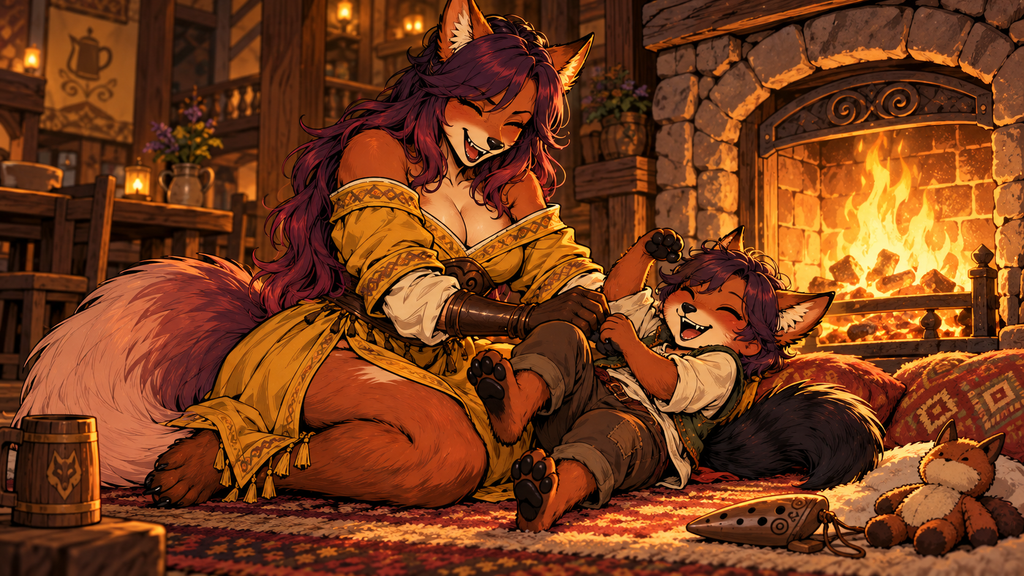
A Patrons & Paragons portrait, by Thalyrune Vokh’essa
If you have ever arrived at the Mughouse feeling like a stranger and left with someone pressing a second helping into your hands, you have probably met Mara Hearthsong.
And if someone has politely informed you that your boots belong off the table and your insults toward the staff belong outside, you have definitely met Mara.
She is our floor supervisor, our resident Vulpine songbird, and quite possibly the only woman in creation who can tell an entire room of quarrelsome adventurers to behave themselves and have them apologize for troubling her.
I am the Hearthkeeper. Mara, I think, has earned the name Heartkeeper.
Do not confuse the two. I tend the fire. She is rather better at remembering who needs to sit beside it.
You may know her by her russet fur, dark locks, ready laughter, and the formidable look she gives anyone tracking mud across a freshly scrubbed floor.
But I would like you to know the woman beneath that smile.
She came to us during the Age of Awakening, when magick had returned to Sangara and the Xin Empire was splitting beneath the strain. She had been enslaved, and she had a baby to protect.
Her husband, Tobin Hearthsong, was a paladin of Avara in a land where his faith was forbidden. By Mara’s telling, he was a dreadful singer and a shameless maker of jokes, but always the first to protect a frightened family. He died defending others. Mara was captured afterward, still carrying their child.
She named that child Justice.
At the time, imperial law recognized the children of enslaved parents as freeborn. A miserable compromise, certainly, but to Mara it meant something precious: whatever became of her, her son might have a life that belonged to him.
She endured more than I shall recount here, holding fast to that promise.
Then the Empire fractured. Provincial commanders began rewriting laws they had no right to change. One announced that even children already born free could be enslaved. It was not the Goddess-Empress’s proclamation. It was the cruelty of men who discovered nobody was near enough to stop them.
Mara looked at her son and decided that was quite enough waiting for the world to become reasonable.
I admire that decision more than I can say.
She had heard travelers speak of a tavern beyond the roads, where wanderers might find refuge. There were no directions she could trust. No guarantee the stories were true. Only a name: the Mughouse.
So she fled with baby Justice tucked against her chest, a few blankets, and Tobin’s little clay ocarina. An entire life reduced to what one exhausted mother could carry.
Somewhere in the winter woods, Lord Caledriss found her trail. His wicker hounds pursued them through the snow. By the time Mara saw our windows, she had spent nearly every last bit of strength she possessed.
I remember that night rather clearly.
There was a sound outside the door: not a knock, exactly, but a body falling where no body ought to fall. Beyond our golden hearthlight lay a Vulpine woman, half-frozen and curled around a tiny bundle. Behind her, the hounds were leaping.
I stepped across our threshold for the first time.
The creatures did not reach her. I saw to that. My shadows were less restrained than my manners, and the snow was shortly full of broken wicker. I believe a few patrons still tell rather extravagant versions of the spectacle.
What I remember is Mara trying, even then, to turn her body between the danger and her sleeping child. She had nothing left with which to fight, and still she was protecting him.
I knelt beside her. She could barely speak, except to tell me about her baby.
His name was Justice, she said.
I thought it a beautiful name.
Behind us, Caledriss and the surviving hounds were approaching. I had no particular interest in their opinion of events. Vyce was at the door, and the other patrons were already rising. They could attend to the hunter. I had two guests who needed warmth.
I helped Mara inside and welcomed her to the Mughouse.
That sounds like a very small thing, does it not? A welcome. A blanket. A place beside the fire.
I have seen wonders that would overturn the minds of mortal scholars. Few matter to me quite as much as the moment Mara realized nobody here intended to take her son away.
And before any of you decide that makes me her savior, allow me to correct you. Mara had already saved herself. She had chosen to run. She had carried Justice through that terrible winter. I merely opened the door at the end of the road.
What she did afterward is why I am writing about her now.
For a while, she needed rest, food, and the chance to wake without orders shouted through a locked door. She needed, too, to learn that someone else could watch Justice while she slept.
It did not happen all at once. Safety is not a spell one casts upon a person. It is something they discover, a little at a time, when the morning comes and the door remains unlocked.
Then Mara began to help.
At first she brought dishes to the kitchen because she couldn’t bear to sit idle. Then she was greeting nervous newcomers, helping overwhelmed waitresses, and persuading quarrelsome mercenaries to sing instead of fight.
One day I realized she had arranged the entire floor with such efficiency that even Pïppers could not disrupt it for more than three minutes. That, dear reader, is a managerial miracle of the highest order.
I offered her the position of floor supervisor. She asked whether I was certain.
I told her I had been certain for some time.
Now Mara watches over our staff, knows which regulars want company and which need quiet, and can settle a disagreement with one raised eyebrow. She can send a rude customer on his way with such flawless courtesy that he sometimes thanks her for it.
Do not mistake her generosity for meekness. Mara has a temper, a quick tongue, and a stubborn streak to rival any mountain goat. She will argue with Vyce, with me, and with anyone who mistakes kindness for weakness.
There is mischief in her, too. She sings ballads that grow decidedly less respectable after the second round, enjoys making the self-important blush, and possesses a remarkably innocent smile for a woman who knows precisely what she has just implied.
I would not have her otherwise.
Her life belongs to her now. She is free to laugh too loudly, flirt shamelessly, make mistakes, and enjoy gloriously imperfect days. She need not spend every waking moment being admirable because she survived something dreadful.
And then there is her music.
Mara has a fine voice, rich and warm enough to reach the farthest table without ever feeling distant. Some nights she sings a rollicking tavern tune and has the whole room stomping along. Other evenings she chooses something quiet, and the conversation settles around her like a blanket.
There is a melody she knows by heart, only a few simple notes, from the ocarina her husband once played. I have heard her humming it while carrying clean linens. I have heard Justice trying to find it on that very instrument, brow furrowed in concentration.
He is older now, that little fox of hers: gentle, observant, and thoughtful. He resembles his mother, save for the black tail that earned him the name Little Blacktail. He treasures his father’s ocarina, and he and Tessa Blackwell have a talent for discovering places their elders wish they’d leave alone.
Mara pretends to be exasperated when the pair return from their adventures. Sometimes she really is. But I have seen her stop in the middle of a busy evening simply to watch Justice laughing with his friend.
There is an expression she wears at such moments that I will never quite find the words to describe.
Relief, perhaps. Wonder. The recognition of a future she once feared she had lost.
She has not forgotten the past. Sometimes a harsh voice catches her unprepared, or a winter wind leaves her quieter than usual. And sometimes she remembers Tobin’s laughter so sharply that she needs a moment to herself.
But grief is not the sum of her life. Neither is suffering.
Ask Mara about her son, and her face lights up. Ask her about music, and you may lose an afternoon. Ask her whether the supper rush is under control, and she will inform you that it would be if certain people stopped distracting her staff.
That last remark is usually directed at Vyce.
We do not keep Mara here out of gratitude, obligation, or pity. She stays because this is her home, because she has chosen to make it so, and because the Mughouse is better for having her in it.
There are those who believe a hearth is simply a flame guarded from the cold. They forget that someone must also offer a chair, set another place at the table, and notice the person too frightened to ask if they may stay.
Mara notices.
Once, in the snow, she reached our door with no strength left to cross it. Now she is so often the first to welcome someone else through.
And when I see her there, laughing with the staff, carrying a warm plate to a weary traveler while her son plays somewhere near the fire, I remember the words I offered her on that dreadful winter night.
You’re at the Mughouse now. And you’re very welcome here.
I meant them then.
I am rather glad she believed me.
— Thalyrune Vokh’essa
Hearthkeeper of the Mughouse
Song
Read The Lyrics!!!
[Intro – Four-note clay ocarina, soft piano, lonely violin]
[Verse 1 – Youthful male solo, intimate]
I don’t remember winter roads,
Or branches clawing at the sky.
I don’t remember wicker hounds,
Or how you held me when you cried.
I know because you told me, Mum,
And sometimes others tell me too.
But every time you reach that door,
Your voice grows quiet halfway through.
I know the way you laugh at dawn,
The songs you hum while sweeping floors.
I know there’s always room for one
More wanderer behind our doors.
[Chorus – Soaring Celtic symphonic power metal]
I don’t remember the snow,
But I know what you went through.
I know the life I get to live
Is here because of both of you.
One stood when others needed help,
One walked when all the roads were gone.
And now I get to greet the world,
And wake to see another dawn.
I don’t remember the snow,
But I know who brought me home.
[Verse 2 – Driving guitars, bright strings]
You tell me Father made bad jokes,
And couldn’t sing to save his life.
But he could make an ocarina
Sound like stars on summer nights.
He stood for people he could save,
Though he had every cause to fear.
He never got to hold my hand;
He left his little music here.
When I get lost inside a tune,
I stop and try those notes once more.
I wish that I could ask him things,
Or hear his boots come through the door.
[Pre-Chorus – Rising violin, earnest]
You say he’d want me to be kind,
To find my voice and make it true.
So when I play his little song,
I’m playing it for him—and you.
[Chorus – Full orchestra and double-kick]
I don’t remember the snow,
But I know what you went through.
I know the life I get to live
Is here because of both of you.
One stood when others needed help,
One walked when all the roads were gone.
And now I get to greet the world,
And wake to see another dawn.
I don’t remember the snow,
But I know who brought me home.
[Verse 3 – Rhythm softens, building again]
They wrote my freedom on a page;
You kept it safe against your heart.
Then men who’d never known our names
Decided they could tear it apart.
You had a choice no one should face:
Stay in chains, or run with me.
You took your baby in your arms
And chose the life I get to lead.
[Bridge – Piano and ocarina, vulnerable solo]
They say you saw the hearth ahead,
So close its gold lit up your face.
They say you fell before the door
And couldn’t crawl another pace.
You held me underneath your coat,
While all the wicker jaws came down.
And even then you spoke to me
Like I was safe and sound.
[Pause – Almost silence]
I wish that I could tell you then
What I can tell you now:
You didn’t fail me in the snow.
You never let me down.
[Build – Strings rise, thunderous drums enter]
The stars came roaring through the dark;
A stranger reached beyond the flame.
She tore the wicker hounds apart
And held you in the light.
But Mum, before that door swung wide,
Before the stars could fill the night,
You’d carried me through every mile.
You’d already chosen life.
[Final Chorus – Huge triumphant soaring solo]
I don’t remember the snow,
But I remember what you’ve made:
A home where I can laugh with friends,
And never have to be afraid.
My father’s song is in my hands,
Your courage beats beneath my own.
You both gave everything you could
So I could have a life to grow.
I don’t remember the snow,
But I know I’m not alone.
[Outro – Instruments fall away, young male solo and ocarina]
So when you hear me laugh with Tessa,
Or see me running through the hall,
Please know I haven’t missed the gift.
I understand it all.
You don’t have to brave the winter.
You don’t have to run again.
Come sit beside me by the fire,
Mum. I’ll play his song for you.
[Four ocarina notes – Soft, peaceful ending]


