
Sebastian Tenoir — Of the Clockwork Choir
Written by Thalyrune Vokh’essa, Heart of the Mughouse
Sebastian Tenoir came to the Mughouse intending to stay one night.
This is how these things often begin.
A traveler finds the door when they are tired enough to stop pretending they do not need one.
They step inside.
They eat.
They drink.
They rest.
Then morning comes, and the road asks for them again.
Usually, they answer.
Sebastian did not.
Not immediately.
He stayed another night.
Then a week.
Then a month.
Eventually, someone stopped asking when he planned to leave.
I believe it was Vyce.
He is surprisingly good at recognizing when a question has already answered itself.
Sebastian is difficult to overlook.
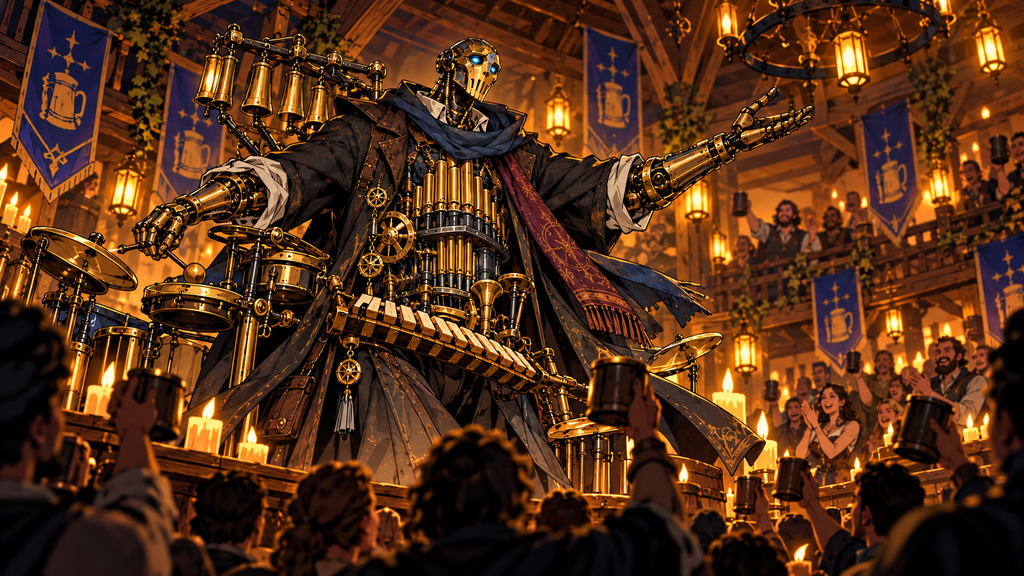
He is extraordinarily tall, even when he folds himself inward beneath his coat and cloak in an effort to appear smaller. Warm brass and gold beneath dark, worn fabric. Blue light behind his eyes. Gears, plates, mechanisms, and a face built rather than born.
The first thing most people notice is his size.
The second is how desperately he tries not to make it anyone else’s problem.
He ducks beneath doorways that do not require ducking.
He hunches when speaking to smaller guests.
He keeps his hands close to himself.
He moves slowly in crowded rooms.
There is something almost apologetic about the way he occupies space.
I noticed that before I ever heard him sing.
I disliked it immediately.
Not Sebastian.
The apology.
The Mughouse has accommodated dragons, gods, demons, giants, creatures without conventional geometry, and once something Vyce insisted was “probably safe” despite possessing seven mouths.
We can manage one tall gentleman.
I told Sebastian as much.
He thanked me.
Then continued ducking.
Some habits take longer to unlearn than others.
Sebastian comes from the Clockwork Choir.
That name confuses people.
They hear “Choir” and imagine a collection of singers standing neatly in rows.
That is not entirely wrong.
It is simply incomplete.
A member of the Clockwork Choir can be a choir unto themselves.
Sebastian’s mechanisms do more than move him.
They make music.
Gears establish rhythm.
Internal chambers carry resonance.
Metal hums.
Mechanical voices layer over one another until one performer becomes many.
Sebastian can change his voice as easily as another musician changes instruments.
Sometimes he sings with one voice.
Sometimes several.
Sometimes the room feels as though an entire cathedral has found its way inside his chest.
The first time he performed in the Mughouse, conversation slowly stopped.
Not because he demanded attention.
Sebastian rarely demands anything.
People simply listened.
Even Pippers.
For nearly a full minute.
I consider this among Sebastian’s more impressive accomplishments.
He calls himself Sebastian Tenoir, of the Clockwork Choir.
The words matter.
The Choir was real.
So was what happened to it.
Much of it is gone now.
Destroyed.
Scattered.
Reduced to a handful of survivors carrying songs that once belonged to many more voices.
Sebastian does not speak about that loss often.
He does not need to.
Grief has habits.
It settles into people.
Into pauses.
Into the way they handle old names.
Into the songs they choose when they believe no one is paying attention.
I am always paying attention.
It is part of my nature.
Sebastian wandered for a very long time after the Choir fell.
World after world.
City after city.
He found places that welcomed him for an evening.
Some welcomed him longer.
There were halls where people admired his music.
Taverns where travelers bought him drinks he could not properly enjoy.
Temples fascinated by his construction.
Workshops whose owners were rather too interested in discovering how he worked.
There were places he nearly stayed.
Nearly is an unpleasant word.
It can contain years.
Eventually, the road carried him to us.
Or perhaps we carried ourselves to him.
With the Mughouse, the distinction becomes unhelpful.
Vyce found Sebastian first.
This should concern you less than it normally would.
He offered him a room, something to eat if he wanted it, somewhere dry to stay, and a place to sing if the mood struck him.
No contract.
No grand promise.
No declaration that destiny had finally delivered Sebastian to his proper home.
Just a room.
A stage.
And the suggestion that he rest.
Sometimes the correct invitation is a small one.
Sebastian accepted.
One night became two.
Then several.
He began helping without being asked.
A chair would be moved before someone struggled with it.
A heavy crate would mysteriously reach the correct room.
A nervous guest would find Sebastian nearby, speaking softly in whatever voice seemed least intimidating.
He learned which floorboards complained beneath his weight.
He learned to avoid them.
He learned the kitchen schedule.
He learned that Pongo becomes dangerous when someone relocates inventory without updating her.
He learned that Pippers considers his internal musical mechanisms “an unreasonable competitive advantage.”
He learned that Vyce dances badly on purpose.
I remain unconvinced about that last one.
Then Sebastian began performing more often.
Not every night.
That would make it work.
Sebastian sings when there is something worth giving.
A loud room might get rhythm.
A celebration might get brass, percussion, layered voices, and enough sound to shake dust from beams that have existed in six different realities.
A quieter evening gets something else.
One voice.
Perhaps two.
Something soft enough that conversations can continue beneath it.
He understands that music does not always need to be the most important thing happening in a room.
That is why he became our Songkeeper.
Bard would also be accurate.
Musician certainly.
Performer, yes.
But Songkeeper suits him better.
Sebastian remembers.
Songs.
People.
Voices.
Places.
He carries them.
Some musicians perform because they want to be heard.
Sebastian often performs because he does not want something else to be forgotten.
There is a difference.
The Mughouse understands that difference very well.
We remember things here.
Sometimes things their own worlds have misplaced.
It is one of the reasons Sebastian fits so comfortably beneath my roof.
Though comfortable may not be the word he would use.
Sebastian remained careful for a long time.
Polite.
Helpful.
Grateful.
Always grateful.
Too grateful.
There is a particular way travelers behave when they believe hospitality has an expiration date.
They keep their belongings ready.
They avoid taking up too much room.
They ask before doing things they have already been told they may do.
They thank you for ordinary kindness as though you have performed a miracle.
They never quite unpack.
Sebastian did this.
For months.
His room looked occupied but temporary.
His coat was always placed where it could be taken quickly.
The few things he carried remained arranged for departure.
He had lived too long as a guest.
Guests are careful.
Family is inconvenient.
I prefer family.
Family leaves books open.
Family knows which mug is theirs.
Family complains when dinner is late.
Family stops thanking you for allowing them to exist in the room.
I waited.
The Mughouse is good at waiting.
One evening, I passed Sebastian’s room and noticed something different.
Nothing dramatic.
No revelation.
No speech.
There was simply a small collection of belongings on a shelf that had previously remained empty.
Things he did not need for travel.
Things placed for keeping rather than carrying.
It was the first time his room looked like somewhere he intended to return to.
I said nothing.
He would have moved them.
Eventually, one week became one month.
One month became several.
Then a year.
At some point, Sebastian stopped being the clockwork traveler staying upstairs.
He became Sebastian.
Someone asked where he was one evening, and Pongo answered, “Probably in his room.”
His room.
Such small words.
People underestimate them.
Sebastian still wanders sometimes.
He always will.
Some part of him belongs to roads between worlds.
I would never ask him to surrender that.
A home that requires you to become smaller is merely another kind of cage.
So he travels.
He listens.
He collects songs.
He carries pieces of places back with him.
And then, eventually, somewhere in the multiverse, a door appears.
Sebastian steps through it.
He ducks beneath the frame even though I have adjusted it for him.
The staff greets him.
Someone complains that he was gone too long.
Pippers demands to know whether he brought anything interesting.
Pongo asks if he remembered the thing she actually sent him to retrieve.
Vyce offers him a drink out of habit.
And Sebastian comes home.
I do not know whether he thinks of it in precisely those words.
I have never asked.
There are questions whose answers become less important once someone starts living them.
Sebastian Tenoir came to the Mughouse looking for a place to rest.
He found a stage.
He found work worth doing.
He found people irritating enough to miss when he leaves.
And somewhere between one night and one year, he stopped being a guest.
That is the thing about the Mughouse.
People imagine I know when someone belongs here.
Sometimes I do.
But belonging is rarely a decision made all at once.
It is repetition.
A familiar chair.
A voice you expect to hear.
A room waiting upstairs.
A name spoken casually because everyone assumes there will be a tomorrow in which to speak it again.
Sebastian belongs here.
Not because Vyce invited him.
Not because I allowed him to stay.
Not because he sings beautifully enough to make an entire tavern fall silent.
He belongs because one day we all stopped imagining the House without him in it.
Including, I think, Sebastian.
Though he still ducks beneath the doorway.
We are working on that.
— Thalyrune Vokh’essa
Heart of the Mughouse
Character Theme
Sebastian Tenoir
Still I Sing
A mournful clockwork-metal anthem that follows Sebastian Tenoir from the silence left by the fallen Clockwork Choir to the unexpected home he finds at the Mughouse. “Still I Sing” begins as a song of survival and remembrance, then gradually transforms into something warmer: the realization that family can be found again, and that he no longer has to sing alone.
Read The Lyrics
Once we filled a thousand chambers,
Each of us a thousand more.
Brass and breath in perfect measure,
Voices rising through the floor.
Then the music broke to silence.
Then the halls forgot our names.
I carried what was left of us
Inside these turning frames.
[Verse 1]
I walked roads without a number,
Under unfamiliar skies,
With a choir behind my ribs
And no answer when I cried.
Every gear kept turning.
Every spring obeyed its part.
Funny how a thing can function
With an empty place for heart.
I learned to bow beneath the doorways,
Fold these shoulders small,
Lower every heavy footstep
So I frightened none at all.
Strength was never making others
Feel how powerful I could be.
So I spoke softly to the world—
And kept the thunder inside me.
[Pre-Chorus]
One voice for those I remember.
One voice for those unknown.
One voice for every empty place
I learned to fill alone.
[Chorus]
STILL I SING!
Though no answer comes to me!
STILL I SING!
For the voices I can’t reach!
Gear by gear and note by note,
I carry every name.
They could silence all the singers—
But they could never kill the strain.
So while these old hands still can move,
While this heart of brass still rings—
I remember.
I endure.
And still—
I sing.
[Verse 2]
Then I found a door where none belonged,
Warm light beneath the frame.
A room too loud for loneliness.
And someone asked my name.
No prophecy.
No grand design.
No oath I had to swear.
Just food, a room, a little time,
And space enough to stay there.
I meant to leave the next morning.
Then morning came and went.
One night became another.
A week became well spent.
A month became a season.
The seasons learned my song.
And somewhere in that passing time—
I stopped wondering when I’d move on.
[Build]
They asked me once to play for them.
So I opened up my chest.
Let the hammers find their rhythm.
Let the pipes release their breath.
And when the final note was fading,
Something happened I had missed—
Another voice began beside me.
Then another joined with it.
[Chorus]
STILL I SING!
But now an answer comes to me!
STILL I SING!
And there are voices in the harmony!
Gear by gear and note by note,
The empty halls grow warm.
I carried ghosts across the worlds—
And found a place beyond the storm.
I thought survival meant remembering
Everything I’d lost.
Now I know that living means
Still building from the cost.
And still—
I sing.
[Bridge – Quiet, Warm]
I learned to stoop beneath the doors.
To soften every sound.
To fold these iron shoulders
So I wouldn’t frighten crowds.
But here they never asked me
To be smaller than I am.
They simply made a little room
And welcomed where I stand.
I once believed that home was somewhere
You were made to belong.
Now I know it’s where they notice
When you’ve been gone too long.
Where someone saves your place.
Where someone knows your sound.
Where you stop calling yourself a wanderer—
Because you’re finally found.
[Final Build]
So let the gears keep turning.
Let every hammer fall.
Let the old songs live beside the new—
There is room enough for all.
I am not what sorrow ended.
I am not the last refrain.
I am every note I carried
And every note I’ve gained.
[Final Chorus – Full Choir]
STILL WE SING!
And now the whole House answers me!
STILL WE SING!
Different voices, harmony!
Gear by gear and heart by heart,
Hear how the rafters ring!
I crossed a thousand lonely worlds—
Now I have a home to sing!
STILL WE SING!
Let the old bells join the new!
I will carry those I came from—
And I’ll carry this place too!
I am Sebastian Tenoir!
I am one voice!
I am many!
I am of the Clockwork Choir!
I found the Mughouse!
I found my family!
And still—
WE SING!
[Final Refrain]
Still we sing.
Still we sing.
No longer alone—
Still we sing.
[Outro – Slowing, Warm Piano and Clockwork]
The gears still turn.
The song goes on.
And when the final note is done—
I know where I belong.
[Final Sustained Chord]
Home.
[End]


